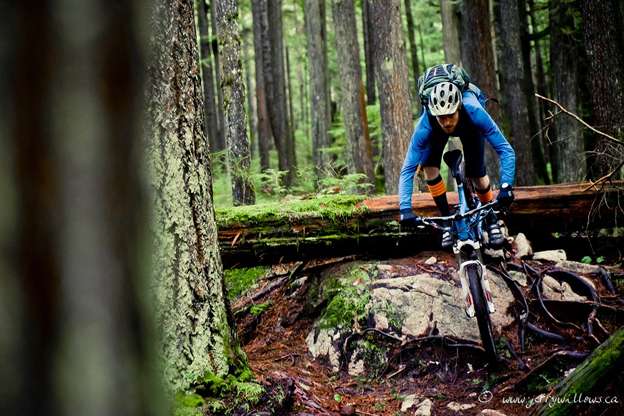
Vid/Interview - Arthur says II
Set up Secrets
Words by Cam McRae.
Date: 2011-11-27
Last week I introduced you to local honch Arthur Gaillot - and his new business venture - Suspension Therapy. (If you missed that interview - which was excellent by the way - click here) Arthur has spent a lot of time looking at riders' suspension set ups, figuring out what they are doing wrong then sorting them out before releasing them to the trails. I asked Arthur to share some of that wisdom with us so we can ride as fast as any pro athlete - because we all know it's all about the bike.
nsmb - Tell me a little about the services you are planning to offer at Suspension Therapy?
Arthur Gaillot - Suspension Therapy offers suspension set-ups for mountain bike applications. My clientele extends from occasional riders who want the most out of their bikes every time they get out, to professional racers who want to ensure that the performance of their suspension is no longer part of the equation. Most clients are avid mountain bikers who want to know that their mid to high-end mountain bike is working optimally for their rider weight, weight placement on the bike, rider ability, and terrain. My goal is to enable my clients to ride forward, push into their bikes, weigh their side-knobs, dig into corners, brake late and hard, carry speed through rough terrain, and feel comfortable where they were previously uncomfortable.
During the hour process, I enjoy improving my clients’ connection to their bikes. For some, a set-up will be an opportunity to gain understanding of the intricacies of their front and rear suspension and proper body positioning. For others, the focus will be on maximizing the current platform (frame/fork/shock/geometry/ergonomics) for less feedback through demanding terrain, better dynamics under power, and minimized strain on the equipment.

Can Arthur Gaillot (shown here with Piper) make your bike perform better? He's confident that he can. Photo ~ Stephen Wilde
How often do you see people riding with the correct set up?
To be perfectly honest, I quite seldom see mountain bikers running a correct set-up. This is not surprising as there is very little information available to the public in regards to what an optimal suspension set-up is. Suspension manufacturers do publish guidelines for damper setting ranges, spring rates / air pressures for a given rider weight and fork or frameset. These guidelines however apply to a damper in isolation (fork or shock only), not to a whole bicycle. Fork height, geometry, suspension design and characteristics, front end height, bar width, stem length, rider measurements / proportions, rider ability and weight bias, fork and rear shock parameters, terrain, all need to be considered when performing a complete (and in my opinion, proper) suspension set-up. Due to the number of variables and because a fork or shock never works in isolation, a suspension set-up is very well suited to a one-on-one, in person procedure rather than to generic information in the form of an online guide. 
Back before Arthur had forsaken 26" wheels. Photo ~ Jerry Willows
Is it difficult to get your bike's suspension dialed in properly?
Considering the number of parameters involved in performing a suspension set-up, I would say yes. As well, different brands of suspension have different damper characteristics and as a result, variable ideal ranges of damper settings. For example, I will be looking at different ideal sags for an Intense 951 with a Cane Creek Double Barrel versus the same frame with a Fox DHX RC4. In this case as well, front-end set-up will noticeably vary, as the front and rear of the bike will have drastically different compression curves depending on which one of the above shocks is used. All this to say that to perform a proper suspension set-up, one has to have a thorough understanding of the following:
- Characteristics of the dampers being adjusted / including ideal damper range for optimal function.
- Suspension design characteristics and how the design complements or compromises the traits of the dampers it is paired with (fork and shock).
- Where the bike is being ridden and in what ways the terrain strains / loads the suspension.
- Rider weight placement considering rider ability and riding style.
- How the above parameters affect front and rear sag ranges and compression curves, and as a result how pronounced the bike’s rearward stance should be.

Arthur, like many riders on the Shore, now favours smaller bikes. Back in the day though he rode burly machines like the Rocky Flatline (above) and even a Hukk. Photo ~ Stephen Wilde
How important is a proper set up?
I cannot stress enough the importance of a proper suspension set-up. A stock bicycle, no matter how high-end it is, will only perform to a very small percentage of its capabilities out of the box. I usually compare a suspension set-up to adjusting one’s driver seat in a new vehicle. It does not matter how expensive or high-end the vehicle is, if your knees are wedged against your chest, or your feet cannot reach the pedals, you will only marginally and very superficially benefit from the ergonomics of your vehicle. From a performance perspective, how would you expect a rally car driver to make an infinite amount of small inputs with the minimum amount of delay, without having each and every control be placed in a completely intuitive manner? Same for a mountain bike: by having your suspension allow you to maintain a forward-neutral stance at nearly all times, no matter what terrain features you face, the rider is only required to make minute adjustments in weight placement to apply more pressure to one end of the bike over the other. As a result the rider will experience the following:
- Limited suspension feedback in heavy compressions, deep berms, or steep lips.
- Limited deflection from roots, and/or rocks, dips, soft surfaces, off-camber terrain.
- Ability to hold a sideline longer, without being sucked down to the center-groove of the trail: increases line selection capabilities, opens up a rider’s options to round-out or square-off corners, gives the rider increased confidence to look ahead.

Arthur guarantees that once your bike is set up you will ride as well or better than Wade Simmons. Or something like that. Photo ~ Stephen Wilde
What are some of the common errors you see?
The most common errors I see are too little rebound damping and improper front to rear balance. The later due most of the time to a fork set up with too low of a spring rate or not enough damper. Both of these lead to:
- Compromised traction under braking, cornering, and climbing.
- Aggravated pedal feedback in technical climbing situations / under power.
- The rider’s weight being constantly shifted forward, which results in an exaggerated rearward riding stance that un-weighs the front-end when it most needs applied pressure (to maintain control).
- Overall, a bike that gets deflected by the terrain and discourages a confident and controlled riding position. Far from ideal.
Also, I find many mountain bikers to have unrealistic expectations regarding rider weight retention/control versus getting full travel. No same/single set-up can give a feeling of control, provide little rider feedback and make use of all the travel both on a Squamish trail ride (read smooth, undulating terrain, with few heavy compressions) and on a typical North Shore or Pemberton ride (read rougher, sharper, multiple heavy compressions and weight shifts). If the terrain being ridden is noticeably varied, a bicycle’s suspension can only be set-up to handle effectively 80% of the riding encountered. The remaining 20% ridden is up to the rider to compensate for. Depending on the rider’s ability and preference, the compromise will be made from different ends of the spectrum: firmer suspension, more controlled, yet not as compliant at slower speeds, or compliant, more comfortable, yet not as controlled at higher speeds and in rough terrain.
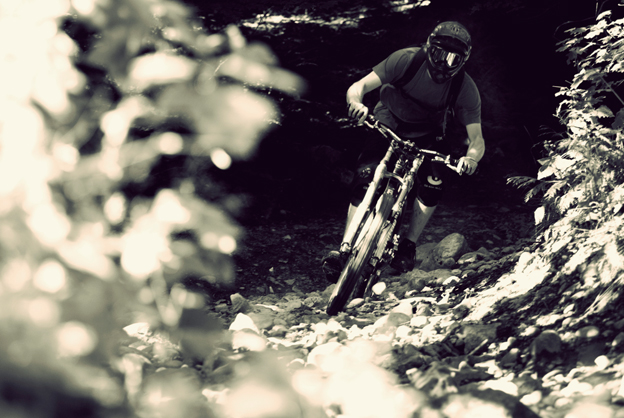
Charging calmly. That's the way Arthur rolls. Photo ~ Stephen Wilde
If you had to give one piece of advice (or perhaps four) about suspension to all riders what would it be?
1. Think of your bike as a whole and never isolate a single component (suspension or not) when problem solving. Everything is linked, and seeing the problem as the compound result of many small factors rather than that of one single component or adjustment is key.
1. A good suspension set-up is one that is optimal most of the time (about 80% in my opinion) and decent the remaining 20% of the time. The 20% of the time is compensated for by rider ability. The more familiar with the set-up a rider becomes, the greater his/hers ability is to compensate. The key is to create a baseline set-up that seldom changes (if ever), a set-up that the rider deems predictable, knows and trusts. Making on the fly adjustments, turning knobs and pushing buttons because the trail/conditions/riding group is different (and comfort level lower), only distances a rider from what is familiar and jeopardizes his or her ability to adapt.
1. With properly functioning suspension components, no adjustment /setting should be at the extreme end of its range. If so, the problem usually lies elsewhere (see 1.), the assembly might need to be serviced, or potentially the suspension component might need to be retuned for a specific application.
1. Give yourself some credit and trust your instincts. Listen to yourself as far as genuine concerns regarding your bike’s handling: if you feel too much feedback from your bike in a given circumstance it is most certainly something that can be lessened or perhaps even corrected entirely with a proper suspension set-up.
Not for the faint of heart. Photo ~ Jerry Willows
Does your approach differ from others? Are there philosophies of suspension set up?
Suspension Therapy, SuspensionWerx, qualified suspension tuning centers and the race and development departments of off-road suspension manufacturers (pedal bike, motorcycle), recognize and apply similar concepts. Of course, with a throttle and heaps of torque, parameters change. The end goal however remains the same: better tracking, less rider fatigue, increased ability to carry speed through rough terrain.
There are certainly riders who appreciate things firmer and others who err on the softer side. Which are you?
I run my bike on the firm side, quite heavily damped both in rebound and compression. The set-up on my Tallboy compromises comfort at slower speeds for control under heavy compressions and through rough terrain: I like being able to run my bike through stuff with as little feedback as possible. It stays this way year round, with very little changes (if at all) to my baseline settings. When I raced in Ashland Oregon last Spring, the terrain was/is so drastically different than home that I ended up running more sag for increased traction in loose, gravelly / sandy corners. The course was long and the more compliant set-up also resulted in less hand fatigue. A minute into my first ride back in North Vancouver it was very apparent that what was right for me in Southern Oregon, was a little terrifying back home!

Will you be able recline on a couch to discuss their suspension issues? It could happen. Photo ~ Stephen Wilde
What will the typical procedure you go through be like?
Before the set-up, I ask my clients questions regarding their bike brand and model, suspension components, date of last suspension service, rider weight and most ridden areas / trails. This helps me prepare for the set-up, and allows me to perhaps redirect customers towards SuspensionWerx, Marzocchi Canada, Shawn Cruikshank, Sram, or local distribution centers if their suspension components need to be serviced before they can be set-up. At time of set-up, I follow this procedure:
- Assess condition of front and rear suspension components.
- Suggest frame travel/geometry settings (if applicable).
- Put baseline damper settings in fork and shock / spring swap or air pressure adjustment as needed.
- Suggest front-end ride height and ergonomic changes (if applicable).
- Sag test with explanation of percentages of travel recommended for application / why percentages differ front to rear / what balance is trying to be created and why.
- Spring swap / air pressure adjustment as necessary to meet target sag.
- Practical assessment / test ride to fine tune damper settings, spring rates/ air pressures, ensure balance created is maintained throughout travel.
- Settings and measurements recorded on client’s electronic set-up sheet.
- Encourage rider feedback after three to five rides, fine-tune if necessary.
Thank you Cam for the opportunity to introduce Suspension Therapy’s services to the nsmb community. If anyone has any questions regarding my services, please do not hesitate to contact me.
Suspension Therapy
Arthur Gaillot
info@suspension-therapy.com
suspension-therapy.com
Ask your suspension questions below. Or say anything you like.
Comments
Add your comments here! Note that all posts as guests will be put into a moderation queue.
way too much thinking, go ride your bike. these days bikes out of the box are actually awesome. over thinking things will create fear and lack of confidence, and this is where your riding will suffer. dont blame the parts!
i've learned more about suspension in these 2 articles than the sum of my knowledge thus far.
absolute value !! 100 %!
Of course your bike rides awesome already, however taking it to Arthur will bring the bike to it's full potential.
Best upgrade availble , we are lucky to have this service availble to us.
I also recommend having Suspension Werx service your forks and shox an annually.
dialed suspension is the key to achieving Vanderspeeed.....
Arthur is a great guy and bringing your suspension into play properly will help any rider especially those new to the sport. It is great to get help and knowledge from great riders like Arthur who are out everyday pushing the limits and testing!
This "anonymous" guy is posting stupid things all over the internet. Can't we ban him or something?
better to ignore him, it will make him sad
Guest "way too much thinking, go ride your bike. these days bikes out of the box are actually awesome. over thinking things will create fear and lack of confidence, and this is where your riding will suffer. dont blame the parts!"
You don't seem to understand that tweaking your suspension can be difference between a good ride and a ride you talk about for days to you riding buddies.
|
Originally Posted by Guest
(Post 2593043)
way too much thinking, go ride your bike. these days bikes out of the box are actually awesome. over thinking things will create fear and lack of confidence, and this is where your riding will suffer. dont blame the parts!
|
You guys would try and ban someone over a statement such as this?
What is there too much truth in it?
There are two definite trains of thought on this one, I have seen both enough times.
FYI I am a promoter of a dialed in bike, but our guest brings up a valid point.
Ride it like you stole it also works, some people never touch a dial and leave everyone in the dust.
Makes me wonder some times wether they would be any faster with a dialed bike......
I often think no, sometimes the set up and testing only caters to the whiny side of the rider when a big dose of HTFU is what is needed.
In closing, I feel everyone should go and see Arthur, that way they at least know the difference.
as for banning the guest, c'mon kids grow a pair.
Personally, I don't fiddle with my suspension settings too much after I get them dialed in. Maybe I am missing out on a bit of performance by not getting the "pro" tune, but it doesn't make the ride any less enjoyable for me.
I am a devout believer of Arthur and his Suspension Therapy services. He tuned/adjusted my new ride from ok to dialed-in. After our appointment, I found I was carrying more speed, braking less, nose diving less, and no longer getting hung on square edge bumps. My riding friends even commented that I was carrying more speed. I would recommend his service to anyone.
Great article and video Cam.
This article really gets at the qualitative aspects of both bike setup and rider habits. It's difficult to ascribe a specific value to these aspects, but they really are important to those who choose to care.
Great article Cam and love the video.
Might have missed it, was there any mention of cost?
|
Originally Posted by TRD
(Post 2593144)
Great article Cam and love the video.
Might have missed it, was there any mention of cost? |
|
Originally Posted by Guest
(Post 2593043)
way too much thinking, go ride your bike. these days bikes out of the box are actually awesome. over thinking things will create fear and lack of confidence, and this is where your riding will suffer. dont blame the parts!
|
I don't see the issue with getting your spring rates and sag set properly and having some understanding how your bike works. Shops should be helping you with this when you buy a bike, but with the proliferation of buying stuff online I'm sure the market for this service will grow and grow.
|
Originally Posted by clarklewis
(Post 2593091)
better to ignore him, it will make him sad
|
that was a great article/interview. i feel like i have a better sense of just how much i don't know about suspension technology; smart
so (pardon the reductive list) there seem to be three elements that can influence how your suspension performs: condition, tune and setup. condition seems pretty straight forward - but tuning vs. setup are a bit confusing to me. setup would seem to be dependent on, possibly limited by, the tune - static settings and characteristics, range and type of adjustability, etc. - while a proper/custom tune would optimally be done once the suspension has been properly setup, so that any mechanical limitations can be determined and overcome
my question: do i have this right? and would having one's suspension optimized therefor involve having the two elements worked on as a cyclical process where both they feed back into each other until optimal (i like the 80% threshold, seems reasonably) performance is achieved? or is it linear: a then b then c = done
|
Originally Posted by gram
(Post 2593158)
I believe it is $55 + tax for a one hour set up.
|
Dearest sideshow.
I'm sad that you didn't see my comment as the joke that it was intended to be. Indeed, in my haste, I accidentally put in "anonymous" instead of "guest". See, I attempted to create a bit of satire whereby I thought that there was some guy named "guest" who posted stupid things all over the internet and that I was so righteously upset that I insisted we ban him. "Ban him!"
So. There you go. I've explained my joke. And I think it's awesomely amazing that somebody could read an article stressing the finer points of bike set-up and come up with nothing better than "too much thinking, go ride your bike". Other famous quotes from "that guy".
On the financial meltdown:
"Too much thinking, buy gold"
On global warming:
"Too much thinking, exhaust fumes never caused me no bother"
On sex:
"Too much thinking, stick pointy thing in hole"
|
Originally Posted by Dirk
(Post 2593192)
Dearest sideshow.
I'm sad that you didn't see my comment as the joke that it was intended to be. Indeed, in my haste, I accidentally put in "anonymous" instead of "guest". See, I attempted to create a bit of satire whereby I thought that there was some guy named "guest" who posted stupid things all over the internet and that I was so righteously upset that I insisted we ban him. "Ban him!" So. There you go. I've explained my joke. And I think it's awesomely amazing that somebody could read an article stressing the finer points of bike set-up and come up with nothing better than "too much thinking, go ride your bike". Other famous quotes from "that guy". On the financial meltdown: "Too much thinking, buy gold" On global warming: "Too much thinking, exhaust fumes never caused me no bother" On sex: "Too much thinking, stick pointy thing in hole" |
Seriously Cory - of all the people to miss Esarc...
that was a lot of information! Think I'll pay the bucks and get my next bike set up by the pro!
Who cares about the article, the video rocks. Good stuff.
|
Originally Posted by boomforeal
(Post 2593179)
would having one's suspension optimized therefor involve having the two elements worked on as a cyclical process where both they feed back into each other until optimal (i like the 80% threshold, seems reasonably) performance is achieved? or is it linear: a then b then c = done
|
- Practical assessment / test ride to fine tune damper settings, spring rates/ air pressures, ensure balance created is maintained throughout travel.
- Settings and measurements recorded on client’s electronic set-up sheet.
- Encourage rider feedback after three to five rides, fine-tune if necessary.
Seems to me that not only is it a process, but one that Arthur wants feedback on and is willing to follow up with.
This is similar to the way we approach bike fit. I recommended the 17x100 stem for your road bike, and would like to talk to you about it after you've spent some time on it. (Of course, you're going out of town before that can happen, but I'll keep my eyes open for a 17x100 25.4 Thomson for you ;) )
Let's face it. I'm gonna tell all my riding buddies this isn't worth too. Why would I encourage them to be better,faster riders than me.
(in response to "guest")
I'm curious. Is this a real world set up or a parking lot set up?
I'd like one bike dialled for the Shore and another for Whistler.
What I would give to carry more speed at Whistler....
But I think you need a genuine wash board to get that Garbonzo feel.
|
Originally Posted by Oldfart
(Post 2593176)
Ignore who?
|
helluva video, eh?!
P.s. Loved the video too. Do you think Santa would deliver me a run on Ladies like that one? Can skill be packaged and shipped from China. Are batteries included?
I'm a bit suprised that everyone is so gung-ho for paying for this service. It's pretty simple, something most people could do themselves. he says for most people he puts in a stiffer springs and cranks up compression.
I like that this is even being discussed nowadays. 6 years ago
I bought my first trail bike and have had to learn all of it on my own with trial and error. Even last year, I rode my new M9 my first time at Whistler with no comp front or rear...I could have killed myself pogo-ing all over the place. (Granted, I never looked up the recommended settings on the Intense site and realized how much of a moron I am). Arthur's service is worth so much more than the $55 bucks. Case in point; Everyone knows how to swing a golf club right?? Pffft! You need someone to watch you with your gear.
|
Originally Posted by CarbonCopy
(Post 2593254)
I'm a bit suprised that everyone is so gung-ho for paying for this service. It's pretty simple, something most people could do themselves. he says for most people he puts in a stiffer springs and cranks up compression.
|
|
Originally Posted by morgman
(Post 2593234)
Seems to me that not only is it a process, but one that Arthur wants feedback on and is willing to follow up with.
|
but, i'm wondering where changing the actual characteristics of the suspension comes in. is the set-up about optimizing what you've got, or is consideration given to what changes (to or of the equipment) might better serve the rider? for example with an rp23 shock, one can set up the rebound and air pressure to optimize their performance - but if the suspesion design of the frame would be better served by a more linear shock, or if the velocity tune is wrong for the rider's weight and riding style, how do these issues factor in?
he'd suggest getting james to re-tune the shock, with which they have a lot of experience. even rp23 has quite a range. the stock tune is usually aimed at the average bear, which may or may not be what you need.
I had my suspension set up by arthur a couple of months ago. I'd picked up a new bike and was having way too much trouble getting it dialed. One hour with Arthur, and my riding has returned to what it was like on my previous bike, which was stolen. In fact, it's better. I only wish I'd gone to see Arthur about this years ago. My particular problem was running everything too soft. I didn't realize it happening over time, but i was running the shock on my old SX softer and softer every time i got it serviced. In response, I was running my fork softer and softer, until it just got very difficult to ride. Arthur recognized this very quickly and got it set up better than any bike i'd ever ridden. He also made some recommendations (a suspensionwerx rebuild, which was due, a stiffer spring, and the fancy new fox seals), in addition to a bar height adjustment. I went from suspension that was better than any i'd experienced to something even greater. The bike has small bump compliance, but more importantly, a lot of support mid-stroke. Best of all, Arthur was able to put into words the preferences which I'd been unable to describe or configure. Before our appointment, i thought i knew suspension, but i was way off. I learned a lot about the way i ride, and the way i need to bike to be set up. I won't claim that I'd be able to grab a new bike and set it up like Arthur, but I'd definitely get closer than I did that last time around.
this service is well worth it. Arthur is awesome and stands behind his work. he's been very explicit in stating that if i have questions or need a tweak, to fire him an email and talk it out.
Many good points were brought up.
Boomforeal -
By communicating with my clients before hand, I am able to assess the condition of their equipment and whether or not the basics are met to justify a set-up. Having done many set-ups now, I am quite familiar with what bikes come with a proper rear shock tune from the factory, and what bikes/rider combinations could use a re-tune for best performance. On some bikes, it is not worth me doing the set-up until the shock is properly tuned (either by SuspensionWerx, or by Fox Canada/OGC). On others, a slight re-tune can be done at time of set-up (change in Boost pressure for example). This is something I will inform a client of on a case by case basis. Now, if during a set-up it is obvious that the shock needs to be re-tuned to suit the application. I would choose to postpone the set-up until the shock is re-tuned, at no cost to my client (only the inconvenience of having to re-schedule).
If need be, I will have a baseline setting chart complemented by an alternative setting chart. If a front or rear suspension component will drastically change in performance after a service, I will indicate, in the alternative setting chart, what settings the fork or shock will have to be set at, after their next service. This ensures my client's set-up is valid when their suspension is working optimally, not just until the next service of either their fork or shock.
morgman -
You are correct. As an example: setting up Ryan Vanderham's Rocky Mountain Flatline for a season of competitive downhill racing. I performed an initial set-up on Ryan's bike pre-season. From understanding his weight placement on the bike, the nature of the terrain he will be racing/riding, characteristics of the bike he was on and the suspension components he was using (Fox 40 / RC4), I was able to establish baseline settings (fork height, bar height, bar tilt, fork and shock spring rates and damper settings). From there he rode the bike five to eight times, before providing me with feedback on the work we had done. I was able to suggest minute adjustments over the phone or by email to tailor our base settings to his needs. In one set-up and three back and forth email/phone exchanges (over the course of three weeks), I created a baseline setting that he used 90% of the time, and an alternative setting that was used for specific courses and terrain only, over the course of a BC/Canada Cup season.
This is the principle I apply to all of my set-ups. Baseline setting that will allow a rider to familiarize him/herself with how their bike is meant to feel, with the option over time to better suit the set-up to potential variables (different terrain, growing rider experience and confidence, variation in rider weight, ....). I like that this encourages a higher level of bike-to-rider connection, as most clients will naturally start to pay attention to how their bikes react in different circumstances (and will have someone to help them make sense of it). A better bike-to-rider connection creates a better rider overall, without a doubt.
I realize this name has already been used but how about a "Brake Therapy" service. Seriously brakes, shut the f*ck up already. I would love to be shown in person how to get them to not squeal. Avid, Shimano, it doesn't seem to make a difference.
without question, spending an hour with Arthur on bike/suspension setup was the best money i've ever spent on my bike. the improvement in performance is noticeable. who doesn't want to shred harder?
Stumble this!
Tweet this!